
Silky, finely diced scallop tartare sits on crisped baguette strips alongside piped, nutty scallop butter and a frozen lemon mousse shaped like sardines, with a concentrated roasted-tomato line for acid and texture.
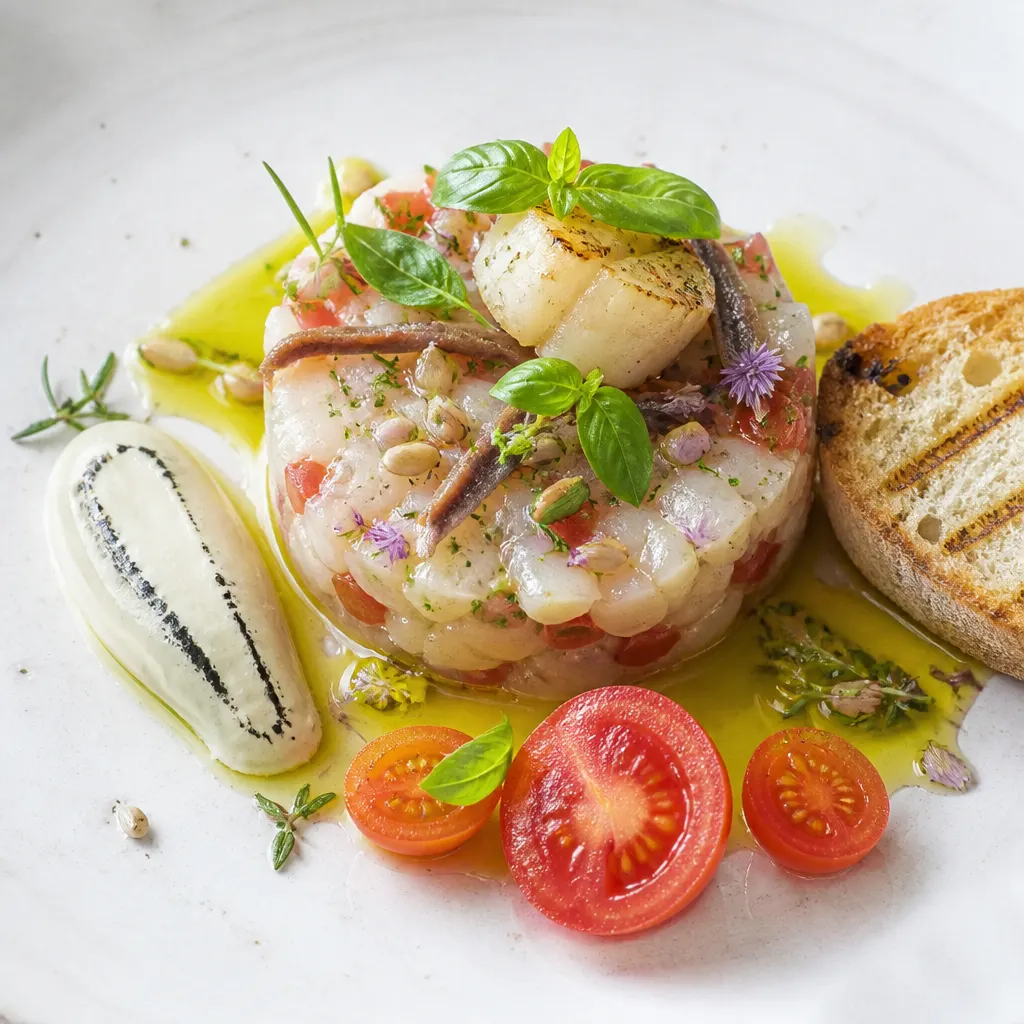
Active prep is about 30 minutes, but several components need chilling or freezing—plan 1–2 days for staging so you can plate these restaurant-style canapés quickly for guests.
Why You’ll Love This Recipe
This recipe layers delicate textures and bright flavors—raw scallop brunoise, a warm-beurre-noisette scallop butter that becomes silky when chilled, and a lemon–tomato mousse that’s frozen in silicone molds for visual impact. If you’re looking for another tomato-forward starter that’s cozy and homey, try this Tomato Basil Soup Recipe (https://yourmomscooking.com/tomato-basil-soup-recipe/) for a contrasting warm option.
The finished canapés look composed and precise—small touches (piped butter, chive blossoms, anchovy strips) make them feel like a restaurant amuse-bouche without impractical last-minute work.
Ingredients You’ll Need
How to Make It
- Extract tomato water: Wash and quarter the ripe tomatoes and halve the cherry tomatoes. Puree both with the basil sprigs, salt, sugar and garlic in a food processor, then line a tall bowl with muslin or cheesecloth and pour the purée into it. Tie the muslin and hang it over a bowl in the refrigerator for 12 hours to collect the tomato water.
- Prep liquid and measure: After the tomato water drains, measure 275 mL and set aside if indicated in later steps (the recipe uses the drained tomato water when building the lemon–tomato mousse).
- Roast the lemons: Wash, dry and wrap each lemon in a single layer of foil. Roast at 150 °C (302 °F) for 1.5 hours, rest them 15 minutes in foil, then carefully peel off the rind, discard any bitter white pith, and finely dice both peel and flesh. Combine peel and flesh in a pot.
- Make the lemon purée: Combine the agar-agar and sugar, fold into the lemon mixture and bring to a boil while stirring, then remove from heat. Transfer to a blender, add the extra virgin oil and freshly squeezed lemon juice, and puree until smooth. Reserve 100 g of this lemon purée and chill.
- Prepare the molds: Brush the silicone sardine-shaped molds with black liquid food colouring and dust lightly with powdered silver to create a sardine-print effect, then set them aside.
- Build the lemon–tomato mousse: Stir the chilled lemon purée with the drained tomato water. Soak the gelatine leaves in cold water, squeeze them, warm the freshly squeezed lemon and lime juice and dissolve the gelatine into that warm juice. Fold the dissolved gelatine into the lemon–tomato mixture, add freshly grated lime zest, then fold in whipped cream and finish with lemon olive oil.
- Freeze the mousse: Pour the mousse into the prepared silicone molds and freeze for at least 4 hours (the recipe uses gelatine as the stabilizer in this step; see ‘Freeze & Unmold Mousse’ below for notes on agar-agar vs gelatine).
- Roast and marinate the tomatoes: Bring water to a boil, blanch the vine-ripened tomatoes briefly and plunge into iced water, peel and quarter them. Remove stalks and seeds, arrange quarters in a baking dish, sprinkle lightly with salt and a little icing sugar, drizzle with extra virgin oil, add thyme and rosemary, and roast at 150 °C until the surface is slightly dried. Cool, then finely chop, season with salt and powdered sugar and marinate with a little olive oil.
- Make scallop-infused brown butter (scallop butter): Heat 1 teaspoon olive oil in a saucepan, add the scallops and cook until their liquid has evaporated, then add the cuttlefish strips. Add a pinch of salt and the rosemary and thyme; briefly cook, then add the butter and cook until it reaches beurre noisette (brown butter). Remove the pan from heat, add the garlic and let it stand for 10 minutes to infuse.
- Strain and season scallop butter: Pass the infused butter through a fine sieve to remove solids and let it cool. Season the strained scallop butter with fish sauce, ponzu sauce and Piment d’Espelette. Place the scallop butter in the refrigerator to cool, stirring frequently as it chills until it takes on a mayonnaise-like consistency, then transfer to a piping bag fitted with a small plain nozzle and refrigerate until needed.
- Prepare the baguette crackers: Cut the very large soft baguette into 4 strips about 15 cm long, 2 cm wide and 1 cm thick. Bake in a preheated oven at 180 °C (356 °F) until golden and crispy, then cool.
- Make the scallop tartare: Dice the very large fresh scallop meat very finely (brunoise). Mix the diced scallop with 1 tablespoon olive oil, 1 tablespoon dashi vinegar and finely chopped chives. Season with Maldon sea salt and 1 teaspoon light soy sauce and keep chilled until plating.
- Assemble and plate: Place 4 small plates on 4 larger flat dinner plates for staging. Spoon a centered line of the marinated roasted tomatoes onto each small plate. Remove the frozen lemon mousse from the silicone molds and place each piece on the tomato line, allowing it to thaw slightly. On each crisped baguette strip pipe alternating dollops of scallop tartare and piped scallop butter along the length, then garnish with chive blossoms. Position each cracker on the larger plates beside the small plate staging. Top each lemon mousse with anchovy fillet strips, a few pine nuts and basil leaves, and finally pour 2 tablespoons olive oil around the mousse on each plate.
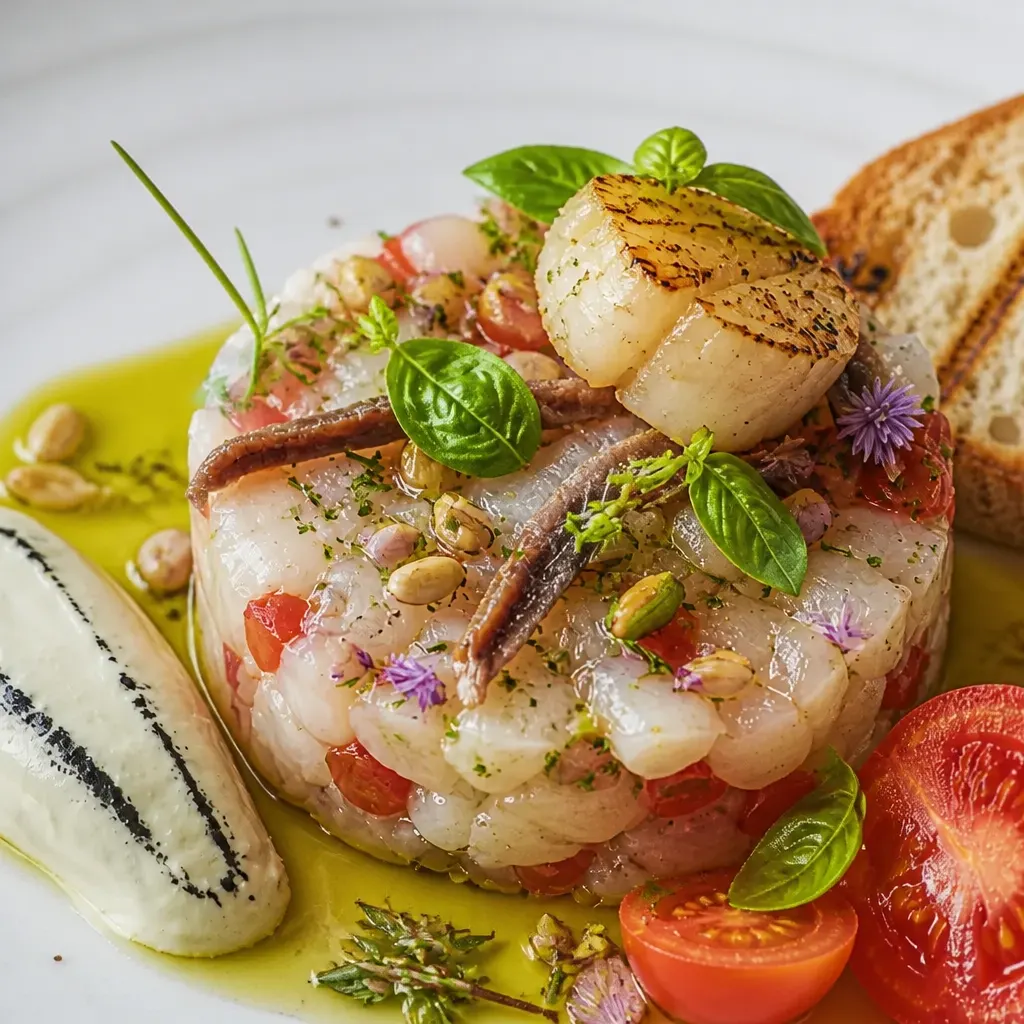
Perfect Tartare Texture
Fine brunoise is the defining detail for restaurant-style scallop tartare. Dice the scallop very finely so each bite is tender and cohesive, not chunky. For another related idea, try Hasselback Potatoes.
- Aim for pieces under 3 mm (a fine brunoise) so the tartare pieces bind with oil and vinegar.
- Mix gently with 1 tablespoon olive oil and 1 tablespoon dashi vinegar—don’t overwork the meat; fold until just combined.
- Chill the tartare briefly before plating so it holds its shape on the cracker without becoming firm.
Stabilize Scallop Butter
The scallop butter is essentially a strained beurre noisette that’s thickened by cooling—proper cooling technique turns it into a pipeable, mayonnaise-like spread.
- After sieving the brown butter, refrigerate it and stir every 5–10 minutes as it cools; this encourages small fat crystals and an emulsion-like texture.
- If the butter separates, re-emulsify by whisking over a cold water bath or briefly using an immersion blender with a small amount of cold lemon juice.
- Season incrementally with fish sauce, ponzu and Piment d’Espelette—taste as you go so the butter complements but doesn’t overpower the raw scallop.
Freeze & Unmold Mousse
Freezing the lemon mousse in sardine-shaped silicone molds creates a striking visual. For the smoothest thaw put the gelatine-stabilized mousse in the freezer at least 4 hours and thaw briefly on plated roasted tomato lines before serving.
- Use the gelatine leaf method described in the recipe for a softer, more homogenized thaw; agar-agar will set when boiled and is more heat-stable but can yield a firmer mouthfeel.
- Brush molds with black food colour and dust silver powder before filling for a realistic sardine print.
- Remove the frozen mousse from the molds and place on the warmish roasted tomato line to allow controlled thawing while you finish assembly.
Tips for Success
Sourcing scallops: Use very fresh, sashimi-grade scallops and keep them chilled; prepare tartare shortly before serving and consume promptly to minimize food-safety risk.
When to use gelatine vs agar-agar: The recipe’s mousse step uses gelatine leaves to give a smooth thawed texture; agar-agar is an alternative listed earlier—use agar if you need a vegetarian set (the recipe includes both, but follow the gelatine dissolving and soaking step for the smoothest thaw).
Achieving mayonnaise-like scallop butter: Cool the strained butter in the fridge, stirring every 5–10 minutes as it drops temperature to encourage emulsification; if it begins to separate, whisk vigorously over a cold bain-marie or add a small splash of cold lemon juice and whisk until smooth.
Make-ahead timing: Collect tomato water, roast lemons and make the lemon mousse 1–2 days ahead (freeze mousse). Make scallop butter and roasted tomatoes the day before; dice the raw scallops and dress the tartare only 30–60 minutes before service.
Save This Recipe
Similar recipes
Frequently Asked Questions
Final notes
Stage components ahead and reserve final assembly for service time—this approach keeps plating calm and ensures every canapé looks composed.
With a little advance prep the finished canapés come together quickly and make a striking starter for dinner parties or special occasions.
Scallop Tartare With Scallop Butter, Anchovies & Tomatoes
Equipment
- Food Processor
- muslin or cheesecloth
- Blender
- silicone molds (sardine-shaped)
- Pot
- oven
- baking dish
- saucepan
- fine sieve
- piping bag
Ingredients
- 500 g ripe tomatoes
- 500 g cherry tomatoes
- 2 sprigs basil
- 1 clove garlic
- 3 lemons
- 2 1/2 g agar-agar
- 100 g sugar
- 25 g extra virgin oil
- 1/2 lemon juice
- 4 leaves gelatine
- 25 g lemon juice freshly squeezed
- 15 g lime juice freshly pressed
- 1 lime zest and juice
- 50 g whipped cream
- 1 tablespoon lemon olive oil
- a few silicone forms shaped like sardines
- powdered silver food colouring
- black liquid food colouring
- 2 vine-ripened tomatoes
- a little icing sugar
- a little extra virgin oil
- 1 sprig thyme
- 1 sprig rosemary
- 1 teaspoon olive oil
- 65 g scallops
- 125 g cuttlefish fresh
- 1/2 sprig rosemary
- 1/2 sprig thyme
- 375 g butter
- 1/2 bulb garlic
- 1/2 tablespoon fish sauce
- 1/2 tablespoon ponzu sauce
- 1/2 teaspoon Piment d’Espelette
- a little soy sauce
- a little lime zest finely grated
- 1/4 baguette very large soft
- 1 scallop very large fresh
- 1 tablespoon olive oil
- 1 tablespoon dashi vinegar
- 1 teaspoon chives
- 1 teaspoon light soy sauce
- chive blossoms
- 4 anchovy fillets
- 1 tablespoon pine nuts
- 8 tablespoons olive oil
- basil
Instructions
- Wash the tomatoes, remove the stems and cut them into quarters.
- Wash and halve the cherry tomatoes.
- Put all the tomatoes in a food processor and puree with the basil sprigs, salt, sugar and garlic.
- Line a tall bowl with muslin or cheesecloth and pour the tomato puree into it.
- Tie the corners of the muslin and hang it from a wooden spoon over the bowl to allow the tomato liquid to drain out.
- Refrigerate the hanging muslin and tomato puree for 12 hours to collect the tomato water.
- Measure 275 mL of water and set aside if needed for other steps.
- Wash the lemons in hot water, pat them dry and wrap each lemon individually in one layer of aluminum foil.
- Place the wrapped lemons in a preheated oven at 150 °C and roast for 1.5 hours.
- Remove the lemons from the oven and let them rest 15 minutes in the foil.
- Carefully peel the lemons, remove any outer pith from the skin and finely dice the lemon peel.
- Remove the white pith and dice the lemon flesh, ensuring no pith remains.
- Combine the diced lemon peel and flesh in a pot and stir.
- Fold together the agar-agar and the sugar until evenly combined.
- Fold the agar-agar and sugar mixture into the lemon mixture in the pot.
- Bring the lemon, agar-agar and sugar mixture to a boil while stirring, then remove the pot from the heat.
- Transfer the hot mixture into a blender jug and let it cool slightly.
- Add olive oil and freshly squeezed lemon juice to the blender and puree until smooth.
- Separate 100 g of the lemon puree and chill it in the refrigerator.
- Brush the inside of the silicone sardine-shaped molds with black liquid food colouring and dust lightly with powdered silver food colouring to create a sardine-print effect.
- Set the prepared silicone molds aside until needed.
- Combine the chilled lemon puree with the drained tomato water in a bowl and stir to combine.
- Soak the gelatine leaves in cold water for a few minutes, then squeeze out the excess water.
- Warm the freshly squeezed lemon and lime juice and dissolve the squeezed gelatine leaves into it.
- Fold the dissolved gelatine mixture through the lemon–tomato water mixture until evenly incorporated.
- Fold in the freshly grated lime zest.
- Fold in the whipped cream and refine the mixture with lemon olive oil to create the lemon mousse base.
- Pour the lemon mousse into the prepared silicone negative molds and freeze for at least 4 hours.
- Bring plenty of water to a rolling boil in a pot.
- Blanch the vine-ripened tomatoes briefly in the boiling water, then plunge them into iced water, peel and cut into quarters.
- Remove the tomato stalks and seeds from the blanched tomato quarters.
- Arrange the tomato quarters side by side in a baking dish and sprinkle with salt.
- Sprinkle the tomato quarters with a little icing sugar and drizzle with a little extra virgin olive oil.
- Add the thyme and rosemary sprigs to the baking dish with the tomato quarters.
- Place the baking dish in a preheated oven at 150 °C and cook until the tomato quarters are slightly dried on the surface.
- Remove the baking dish from the oven and allow the roasted tomato quarters to cool.
- Finely chop the cooled tomato quarters, season with salt and powdered sugar and marinate with a little olive oil.
- Heat 1 teaspoon olive oil in a saucepan, add the scallops and cook until their liquid has evaporated.
- Add the cuttlefish strips to the pan and continue to cook.
- Add a pinch of salt and the rosemary and thyme sprigs and cook briefly to infuse flavor.
- Add the butter to the pan and cook until the butter becomes beurre noisette (brown butter).
- Remove the pan from the heat, add the garlic and let the mixture stand for 10 minutes to infuse.
- Pass the scallop butter through a fine sieve to remove solids and let it cool.
- Season the strained scallop butter with fish sauce, ponzu sauce and Piment d’Espelette.
- Season the cooked scallops with some of the flavored butter, Maldon sea salt, a little soy sauce and some freshly grated lime zest.
- Place the scallop butter in the refrigerator to cool, stirring frequently while it cools until it reaches a mayonnaise-like consistency.
- Transfer the cooled scallop butter into a piping bag fitted with a small plain nozzle and refrigerate until needed.
- Cut the very large soft baguette into 4 strips measuring about 15 cm long, 2 cm wide and 1 cm thick.
- Place the baguette strips in a preheated oven at 180 °C and bake until the bread is golden and crispy.
- Remove the crisped baguette strips from the oven and let them cool.
- Dice the very large fresh scallop meat very finely (brunoise) for the tartare.
- Mix the diced scallop with 1 tablespoon olive oil, 1 tablespoon dashi vinegar and the finely chopped chives.
- Season the scallop tartare with Maldon sea salt and 1 teaspoon light soy sauce and keep chilled until plating.
- Place 4 small plates on top of 4 larger flat dinner plates as a staging for assembly.
- Place a line of the marinated, oven-roasted tomatoes centered on each small plate.
- Remove the frozen lemon mousse from the sardine-shaped silicone molds.
- Place each frozen lemon mousse piece on the line of roasted tomatoes and allow it to thaw slightly while plating.
- On each crisped baguette strip, pipe alternating dollops of the scallop tartare and the scallop butter along the length of the cracker.
- Garnish each scallop cracker with chive blossoms.
- Place each scallop cracker onto the larger plates beside the small plate staging.
- Top the lemon mousse with anchovy fillet strips, some pine nuts and a few basil leaves to garnish.
- Finally, pour 2 tablespoons of olive oil around the lemon mousse on each plate.