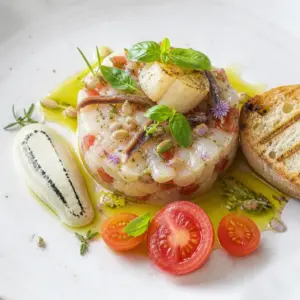
Scallop Tartare With Scallop Butter, Anchovies & Tomatoes
Silky, bright scallop tartare is paired with a nutty beurre noisette scallop butter, roasted tomato line and a frozen lemon mousse shaped like sardines for a textural, savory-sour canapé. Active prep is about 30 minutes, but several components (tomato water, roasted lemons and lemon mousse, and scallop butter) need make-ahead chilling or freezing.
Equipment
- Food Processor
- muslin or cheesecloth
- Blender
- silicone molds (sardine-shaped)
- Pot
- oven
- baking dish
- saucepan
- fine sieve
- piping bag
Ingredients
- 500 g ripe tomatoes
- 500 g cherry tomatoes
- 2 sprigs basil
- 1 clove garlic
- 3 lemons
- 2 1/2 g agar-agar
- 100 g sugar
- 25 g extra virgin oil
- 1/2 lemon juice
- 4 leaves gelatine
- 25 g lemon juice freshly squeezed
- 15 g lime juice freshly pressed
- 1 lime zest and juice
- 50 g whipped cream
- 1 tablespoon lemon olive oil
- a few silicone forms shaped like sardines
- powdered silver food colouring
- black liquid food colouring
- 2 vine-ripened tomatoes
- a little icing sugar
- a little extra virgin oil
- 1 sprig thyme
- 1 sprig rosemary
- 1 teaspoon olive oil
- 65 g scallops
- 125 g cuttlefish fresh
- 1/2 sprig rosemary
- 1/2 sprig thyme
- 375 g butter
- 1/2 bulb garlic
- 1/2 tablespoon fish sauce
- 1/2 tablespoon ponzu sauce
- 1/2 teaspoon Piment d’Espelette
- a little soy sauce
- a little lime zest finely grated
- 1/4 baguette very large soft
- 1 scallop very large fresh
- 1 tablespoon olive oil
- 1 tablespoon dashi vinegar
- 1 teaspoon chives
- 1 teaspoon light soy sauce
- chive blossoms
- 4 anchovy fillets
- 1 tablespoon pine nuts
- 8 tablespoons olive oil
- basil
Instructions
- Wash the tomatoes, remove the stems and cut them into quarters.
- Wash and halve the cherry tomatoes.
- Put all the tomatoes in a food processor and puree with the basil sprigs, salt, sugar and garlic.
- Line a tall bowl with muslin or cheesecloth and pour the tomato puree into it.
- Tie the corners of the muslin and hang it from a wooden spoon over the bowl to allow the tomato liquid to drain out.
- Refrigerate the hanging muslin and tomato puree for 12 hours to collect the tomato water.
- Measure 275 mL of water and set aside if needed for other steps.
- Wash the lemons in hot water, pat them dry and wrap each lemon individually in one layer of aluminum foil.
- Place the wrapped lemons in a preheated oven at 150 °C and roast for 1.5 hours.
- Remove the lemons from the oven and let them rest 15 minutes in the foil.
- Carefully peel the lemons, remove any outer pith from the skin and finely dice the lemon peel.
- Remove the white pith and dice the lemon flesh, ensuring no pith remains.
- Combine the diced lemon peel and flesh in a pot and stir.
- Fold together the agar-agar and the sugar until evenly combined.
- Fold the agar-agar and sugar mixture into the lemon mixture in the pot.
- Bring the lemon, agar-agar and sugar mixture to a boil while stirring, then remove the pot from the heat.
- Transfer the hot mixture into a blender jug and let it cool slightly.
- Add olive oil and freshly squeezed lemon juice to the blender and puree until smooth.
- Separate 100 g of the lemon puree and chill it in the refrigerator.
- Brush the inside of the silicone sardine-shaped molds with black liquid food colouring and dust lightly with powdered silver food colouring to create a sardine-print effect.
- Set the prepared silicone molds aside until needed.
- Combine the chilled lemon puree with the drained tomato water in a bowl and stir to combine.
- Soak the gelatine leaves in cold water for a few minutes, then squeeze out the excess water.
- Warm the freshly squeezed lemon and lime juice and dissolve the squeezed gelatine leaves into it.
- Fold the dissolved gelatine mixture through the lemon–tomato water mixture until evenly incorporated.
- Fold in the freshly grated lime zest.
- Fold in the whipped cream and refine the mixture with lemon olive oil to create the lemon mousse base.
- Pour the lemon mousse into the prepared silicone negative molds and freeze for at least 4 hours.
- Bring plenty of water to a rolling boil in a pot.
- Blanch the vine-ripened tomatoes briefly in the boiling water, then plunge them into iced water, peel and cut into quarters.
- Remove the tomato stalks and seeds from the blanched tomato quarters.
- Arrange the tomato quarters side by side in a baking dish and sprinkle with salt.
- Sprinkle the tomato quarters with a little icing sugar and drizzle with a little extra virgin olive oil.
- Add the thyme and rosemary sprigs to the baking dish with the tomato quarters.
- Place the baking dish in a preheated oven at 150 °C and cook until the tomato quarters are slightly dried on the surface.
- Remove the baking dish from the oven and allow the roasted tomato quarters to cool.
- Finely chop the cooled tomato quarters, season with salt and powdered sugar and marinate with a little olive oil.
- Heat 1 teaspoon olive oil in a saucepan, add the scallops and cook until their liquid has evaporated.
- Add the cuttlefish strips to the pan and continue to cook.
- Add a pinch of salt and the rosemary and thyme sprigs and cook briefly to infuse flavor.
- Add the butter to the pan and cook until the butter becomes beurre noisette (brown butter).
- Remove the pan from the heat, add the garlic and let the mixture stand for 10 minutes to infuse.
- Pass the scallop butter through a fine sieve to remove solids and let it cool.
- Season the strained scallop butter with fish sauce, ponzu sauce and Piment d’Espelette.
- Season the cooked scallops with some of the flavored butter, Maldon sea salt, a little soy sauce and some freshly grated lime zest.
- Place the scallop butter in the refrigerator to cool, stirring frequently while it cools until it reaches a mayonnaise-like consistency.
- Transfer the cooled scallop butter into a piping bag fitted with a small plain nozzle and refrigerate until needed.
- Cut the very large soft baguette into 4 strips measuring about 15 cm long, 2 cm wide and 1 cm thick.
- Place the baguette strips in a preheated oven at 180 °C and bake until the bread is golden and crispy.
- Remove the crisped baguette strips from the oven and let them cool.
- Dice the very large fresh scallop meat very finely (brunoise) for the tartare.
- Mix the diced scallop with 1 tablespoon olive oil, 1 tablespoon dashi vinegar and the finely chopped chives.
- Season the scallop tartare with Maldon sea salt and 1 teaspoon light soy sauce and keep chilled until plating.
- Place 4 small plates on top of 4 larger flat dinner plates as a staging for assembly.
- Place a line of the marinated, oven-roasted tomatoes centered on each small plate.
- Remove the frozen lemon mousse from the sardine-shaped silicone molds.
- Place each frozen lemon mousse piece on the line of roasted tomatoes and allow it to thaw slightly while plating.
- On each crisped baguette strip, pipe alternating dollops of the scallop tartare and the scallop butter along the length of the cracker.
- Garnish each scallop cracker with chive blossoms.
- Place each scallop cracker onto the larger plates beside the small plate staging.
- Top the lemon mousse with anchovy fillet strips, some pine nuts and a few basil leaves to garnish.
- Finally, pour 2 tablespoons of olive oil around the lemon mousse on each plate.
Notes
Notes